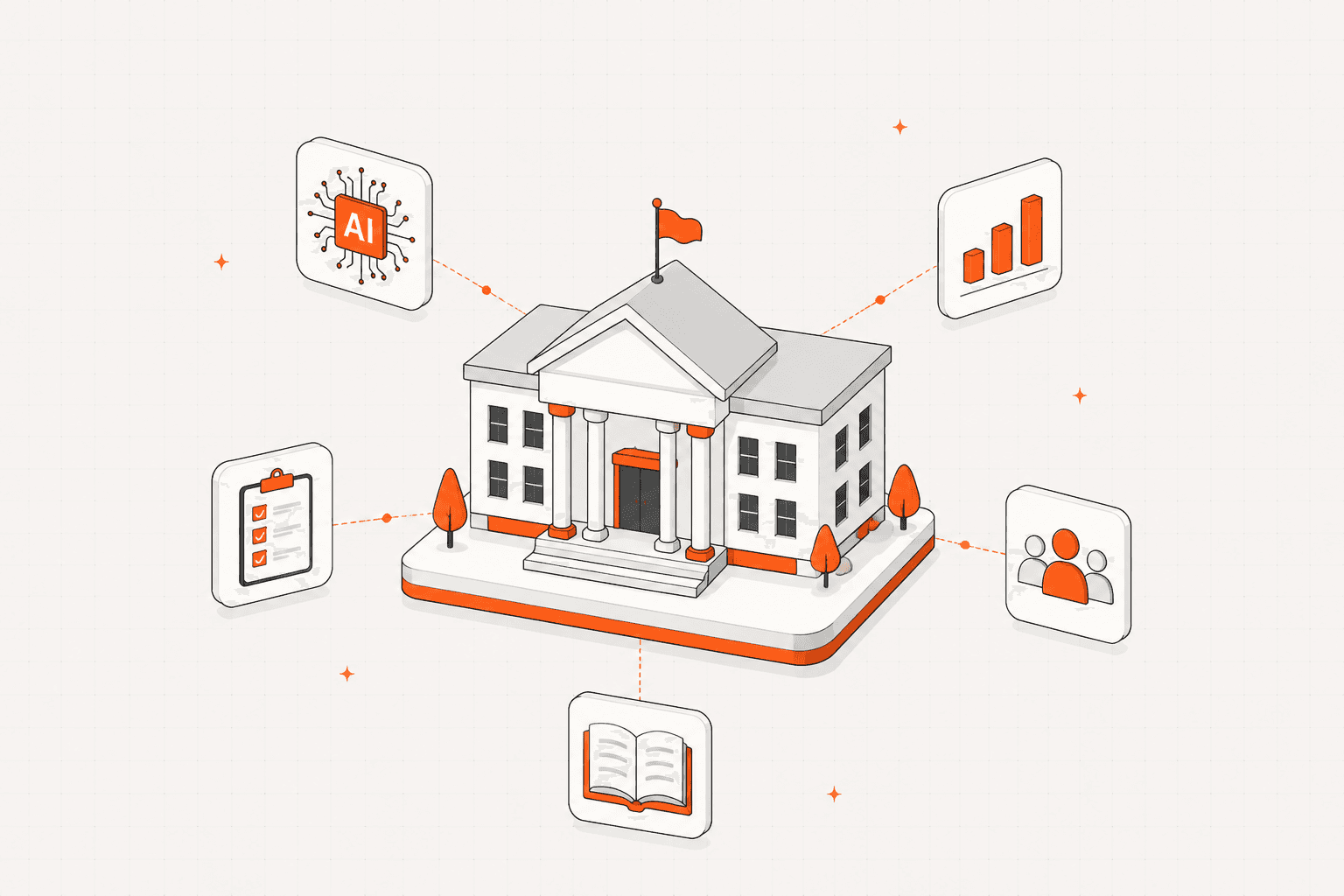
AI in Schools: A Strategic Guide for Educational Leaders
Artificial Intelligence (AI) is no longer a technology of the future—it is becoming an integral part of modern education.
Across the world, schools are exploring how AI can help teachers reduce administrative workload, personalize learning for students, improve assessments, and strengthen academic decision-making.
Yet for many school leaders, an important question remains:
How can AI be implemented strategically to create real educational value?
The answer lies in understanding that AI is not simply another digital tool.
When implemented thoughtfully, AI becomes a strategic capability that helps schools improve learning outcomes, strengthen teaching effectiveness, and make evidence-based academic decisions.
This guide explores how educational leaders can adopt AI responsibly, avoid common mistakes, and build schools that are prepared for the future of learning.
Why AI Matters for Schools
Education is changing rapidly.
Schools today face growing expectations from students, parents, teachers, and governing bodies.
School leaders are expected to:
Improve academic performance
Personalize student learning
Support teacher wellbeing
Increase parent engagement
Use educational data effectively
Prepare students for an AI-driven world
At the same time, teachers face increasing workloads while classrooms become more diverse and learning needs more individualized.
Traditional educational systems often struggle to scale personalized support.
AI helps bridge this gap by enabling schools to make better use of their academic data and giving educators more time to focus on teaching and student development.
AI Is Not About Replacing Teachers
One of the biggest misconceptions about AI in schools is that it aims to replace educators.
In reality, the opposite is true.
Teachers remain central to learning.
They provide:
Mentorship
Classroom leadership
Emotional support
Critical thinking development
Ethical guidance
Professional judgment
AI supports teachers by handling repetitive and data-intensive tasks while providing insights that help educators make better decisions.
The future of education is built on collaboration between human expertise and artificial intelligence.
Where AI Creates the Greatest Impact in Schools
1. Intelligent Student Assessment
Assessment is one of the most time-consuming activities in education.
AI can assist schools by:
Evaluating objective and subjective assessments
Supporting handwritten answer sheet evaluation
Generating personalized feedback
Identifying learning gaps
Tracking student progress
Instead of ending with marks, assessment becomes the beginning of continuous learning improvement.
2. Personalized Learning
Every student learns differently.
AI enables schools to provide learning experiences that adapt to individual needs.
Based on assessment data, AI can recommend:
Personalized practice
Revision topics
Learning resources
Additional support
This helps every student progress at their own pace.
3. Teacher Productivity
Teachers spend a significant portion of their time on administrative tasks.
AI can support teachers by helping create:
Lesson plans
Question papers
Rubrics
Classroom activities
Worksheets
Feedback
Reducing repetitive work allows teachers to dedicate more time to meaningful classroom interactions.
4. Academic Intelligence
One of the most valuable applications of AI is transforming educational data into actionable academic intelligence.
Instead of reviewing spreadsheets and examination reports manually, school leaders gain insights into:
Learning trends
Classroom performance
Subject-wise analysis
Student progress
Institution-wide academic performance
This enables evidence-based educational leadership.
5. Early Learning Gap Identification
Learning gaps often remain hidden until final examinations.
AI identifies these gaps much earlier by analyzing assessment data at:
Chapter level
Concept level
Skill level
Teachers can intervene before learning challenges become larger academic problems.
A Strategic Framework for AI Adoption in Schools
Successful AI implementation requires more than purchasing software.
Educational leaders need a clear strategy.
Step 1: Define Educational Goals
Schools should begin by asking:
What educational problems are we trying to solve?
How can AI improve learning outcomes?
Which teacher challenges require support?
Technology should always serve educational objectives.
Step 2: Start with Assessment
Assessment generates the richest educational data.
Beginning with AI-assisted assessment allows schools to:
Improve evaluation
Generate personalized feedback
Understand learning gaps
Support teachers
Build academic intelligence
Assessment becomes the foundation for future AI initiatives.
Step 3: Support Teachers
Teacher adoption determines AI success.
Schools should:
Provide professional development
Encourage experimentation
Maintain teacher oversight
Build trust in AI systems
Teachers should see AI as an assistant—not a replacement.
Step 4: Use Data Responsibly
AI generates valuable academic insights.
Schools should establish clear policies for:
Student privacy
Data security
Ethical AI use
Transparency
Human oversight
Responsible implementation builds confidence among educators and parents.
Step 5: Measure Educational Impact
AI success should not be measured by software usage alone.
Instead, schools should evaluate:
Teacher efficiency
Student learning outcomes
Learning gap reduction
Feedback quality
Academic improvement
Parent engagement
Technology should demonstrate measurable educational value.
Common Mistakes Schools Make When Adopting AI
Focusing Only on Automation
Many schools adopt AI simply to save time.
While efficiency matters, AI creates far greater value by improving learning outcomes and educational decision-making.
Ignoring Teacher Involvement
AI initiatives succeed when teachers participate in implementation and remain responsible for academic decisions.
Chasing Technology Instead of Educational Outcomes
Schools should avoid adopting AI because it is popular.
Every AI initiative should contribute to:
Better teaching
Better learning
Better assessment
Better educational leadership
Treating AI as a Standalone Tool
AI delivers the greatest value when integrated into existing teaching, assessment, and school improvement processes.
The Role of Principals in an AI-Driven School
Educational leadership becomes even more important as AI adoption increases.
Principals should focus on:
Building a culture of innovation
Supporting teachers
Using academic data effectively
Encouraging evidence-based decision-making
Maintaining ethical AI practices
Technology alone does not transform schools.
Leadership does.
How VedaAI Supports AI Adoption in Schools
At VedaAI, we believe schools should use AI not simply to automate work but to improve learning outcomes.
Our AI Grading & Academic Intelligence Platform helps educational institutions transform assessment into meaningful academic intelligence that supports teachers, students, parents, and school leaders.
With VedaAI, schools can:
Evaluate objective, subjective, and handwritten assessments using AI assistance.
Generate personalized feedback for every student.
Identify learning gaps at chapter, concept, and sub-concept levels.
Provide teachers with classroom insights that improve instruction.
Equip principals with institution-wide academic intelligence.
Enable targeted interventions that strengthen learning outcomes.
Built around the philosophy that assessment should lead to improvement, VedaAI helps schools move beyond marks to create a culture of continuous academic growth.
The Future of AI in Schools
The schools of the future will not be defined by how much technology they use.
They will be defined by how effectively they use technology to improve education.
Artificial Intelligence will increasingly help schools:
Personalize learning
Support teachers
Strengthen assessment
Improve academic leadership
Increase parent engagement
Build evidence-based educational systems
However, the most successful schools will continue to place teachers and students at the center of every educational decision.
Technology should empower education, not replace it.
Final Thoughts
Artificial Intelligence has the potential to become one of the most transformative technologies in education.
However, its success depends not on how many AI tools a school adopts, but on how effectively those tools contribute to teaching, learning, and academic improvement.
For educational leaders, AI should not be viewed as a technology initiative.
It should be viewed as an educational strategy.
Schools that use AI to strengthen assessment, support teachers, personalize learning, and make evidence-based decisions will be better positioned to prepare students for the future while improving outcomes today.
The future belongs to schools that combine innovative technology with visionary leadership and a relentless focus on student success.
What is AI in schools?
AI in schools refers to the use of artificial intelligence to support teaching, learning, assessment, academic analytics, school management, and educational decision-making.
How can schools use AI effectively?
Schools should begin with clearly defined educational goals, implement AI gradually, support teachers through training, maintain human oversight, and continuously measure educational outcomes.
Can AI improve academic performance?
Yes. AI helps improve academic performance by identifying learning gaps early, generating personalized feedback, supporting teachers, and enabling data-driven academic interventions.
What are the benefits of AI for school leaders?
School leaders benefit from institution-wide academic insights, improved assessment data, better resource planning, enhanced teacher support, and stronger educational decision-making.
What is the biggest challenge of implementing AI in schools?
The biggest challenge is not the technology itself but implementing it strategically while ensuring teacher adoption, responsible AI use, and a clear focus on improving learning outcomes.